Understanding Gestures: The Bridge Between Communication and Speech
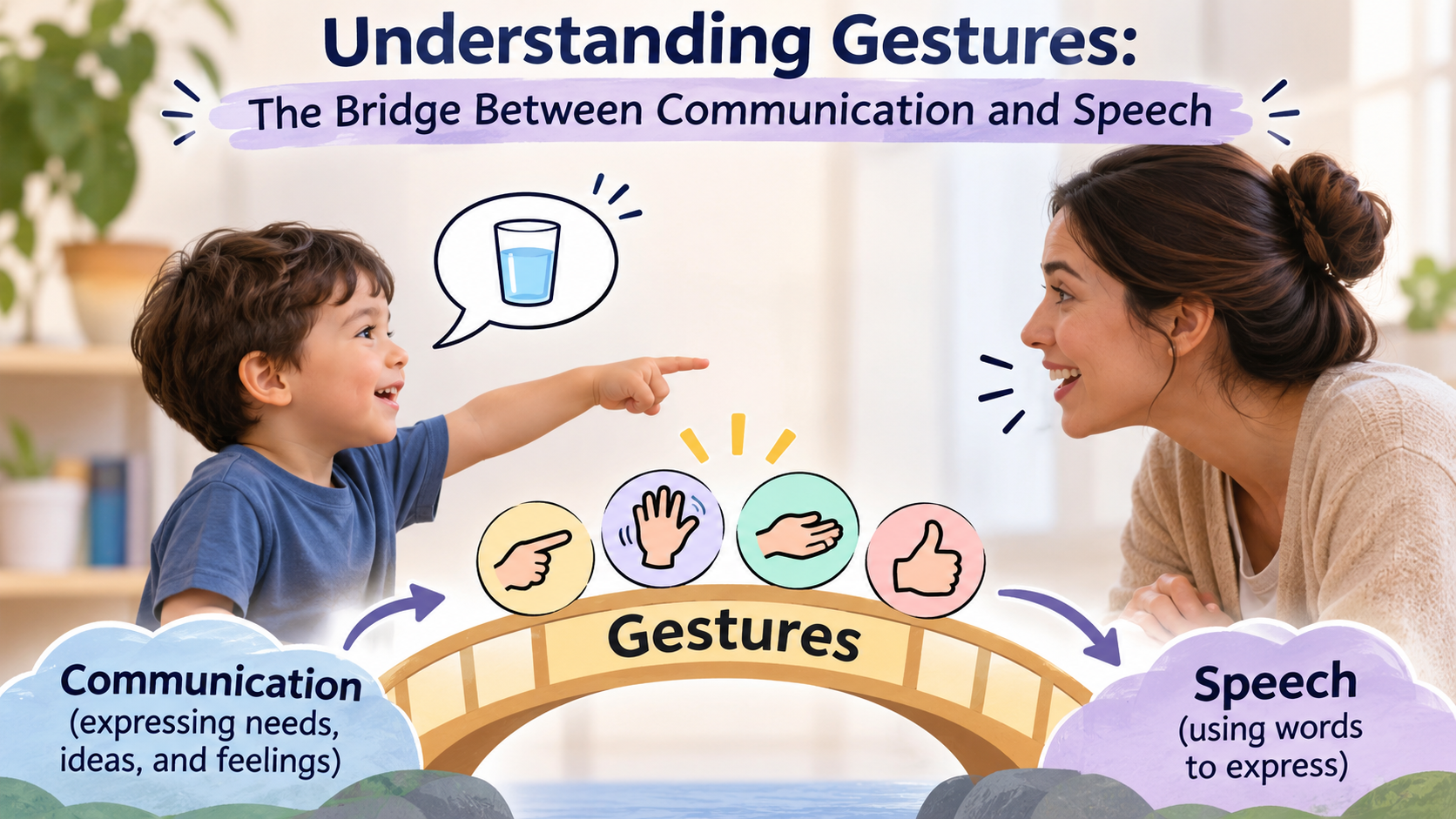
Your child lifts their arms to be picked up, points at the biscuit jar, and waves bye-bye to guests, but hasn't said a single word yet. Should you worry? Not necessarily, especially if your child is under 15 months old.
Those little hand movements are early language. Most babies gesture before they speak, and the gestures they use can tell us a lot about language development . Here's what gestures mean, how they help language grow, and when it's worth getting a closer look.
Gestures are language, not just "extras" Babies gesture before they produce their first words (Bates, 1976). Our hands also help us talk, think, and remember, and sometimes show what a child knows before they can put it into words (Goldin-Meadow et al., 1993). Researchers even suggest that gesture and speech grow from the same underlying system (McNeill, 1992).
So "non-verbal" doesn't mean "non-language." A child who points, waves, and reaches is already communicating with purpose.
How gestures grow into words
Researchers have followed children over time and found a few interesting patterns (Rowe, Ozcaliskan, & Goldin-Meadow, 2008): - Children who point to a wider variety of objects at 14 months tend to have larger vocabularies by 42 months. - Children who combine a gesture with a word tend to build more complex sentences later.
Gestures are a reliable early sign that a child is on the path toward words and sentences.
Gestures and words work together
"If my child can point, won't they be lazy about talking?" No. Pointing and gesturing are stepping stones to words, not substitutes for them. Adults often treat speech as the message and gestures as decoration. For young children, the two work as a team.
Imagine telling a toddler, "Your shoes are under the chair," while pointing beneath the chair. The word "under" describes a spatial relationship, and your hand makes that relationship visible. The same goes for saying "Make it taller" while moving a hand upward, "Turn it around" while rotating your hand, or "Put this one beside that one" while showing the two positions.
These movements do not replace language. They help children understand and connect words with objects, actions, and ideas.
When to seek an evaluation
It's worth having a speech-language pathologist take a look if you notice: ● No pointing, waving, or showing by about 12 to 15 months ● Loss of gestures or words the child used before ● Little eye contact, or no back-and-forth play like peekaboo and taking turns ● Not responding to their name or to simple directions Seeing an SLP early is a check-in, not a diagnosis. If something is off, early support makes a real difference, and if everything is fine, you leave with peace of mind.
What you can do at home ● Naming what your child points to. "Yes, biscuit!" ● Adding one word to their gesture. Model the word, but don't demand it. ● Using gestures yourself while you talk. ● Pausing and waiting, so your child has room to communicate. ● Offering choices by holding up two things. ● Choosing face-to-face play over screens.
Gestures are the bridge between communication and speech.Celebrate every wave, point, and reach by responding with words.
##References## - Bates, E. (1976). Language and Context: The Acquisition of Pragmatics. New York,NY: Academic Press. - Goldin-Meadow, S., Alibali, M. W., and Church, R. B. (1993). Transitions inconcept acquisition: using the hand to read the mind. Psychol. Rev. 100,279–297. https://doi/10.1037/0033-295X.100.2.279 - McNeill, D. (1992). Hand and Mind: What Gestures Reveal About Thought.Chicago, IL: The University of Chicago Press. - Rowe, M. L., Özçalışkan, Ş., & Goldin-Meadow, S. (2008). Learning words by hand: Gesture’s role in predicting vocabulary development. First Language, 28(2), 182-199. https://doi.org/10.1177/0142723707088310