
When Activities of Daily Living are Delayed: The What, Why & How
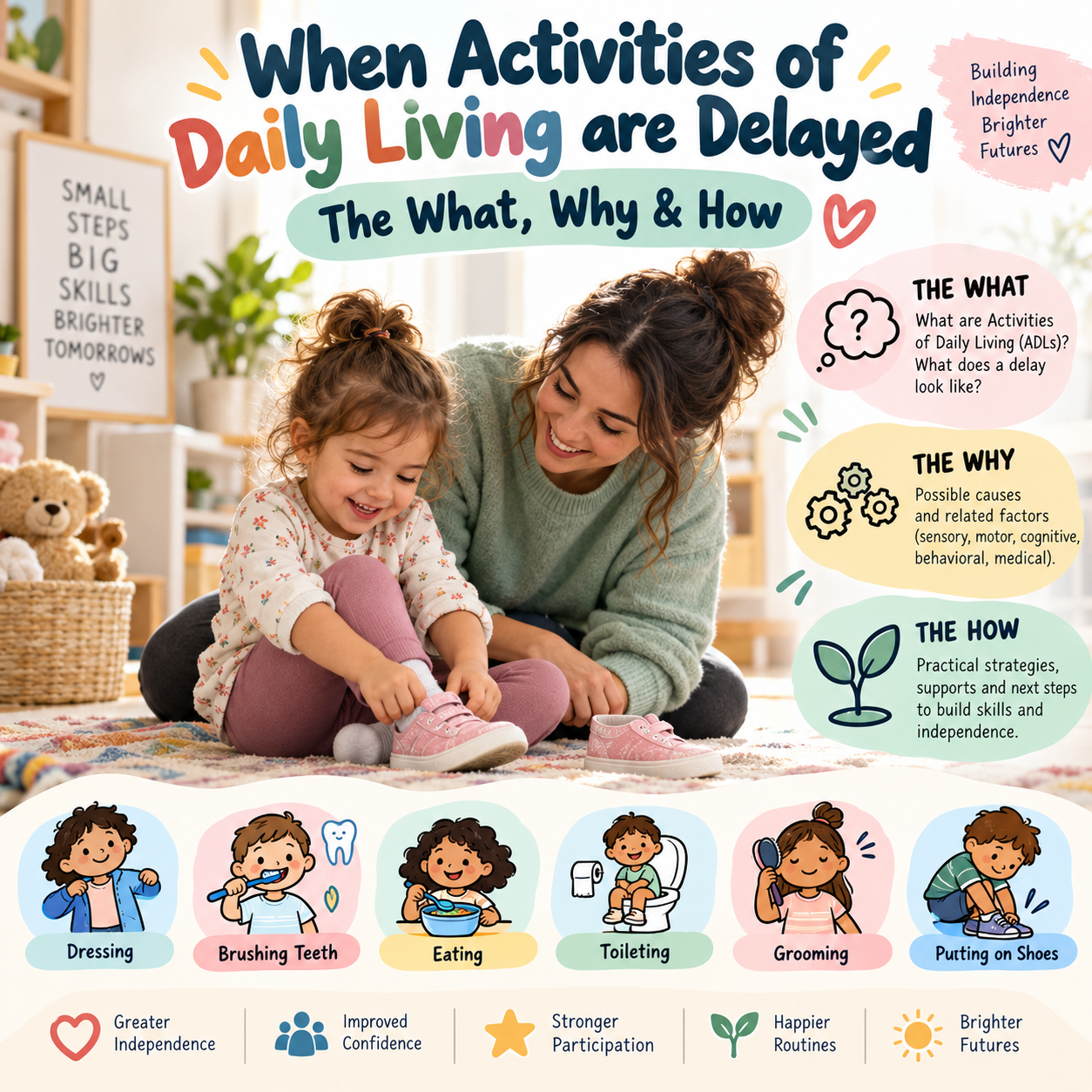
Activities of Daily Living, often called ADLs, are the everyday tasks children learn to do to take care of themselves. Eating, dressing, brushing teeth, bathing, toileting and grooming are all examples of ADLs.
As children grow, they gradually become more independent in these activities. For example, by around two years of age, many children are beginning to feed themselves using a spoon and drink from a cup with increasing independence.
These may look like simple everyday activities, but they involve many different developmental skills working together.
Why can daily living skills be difficult for some children?
A child needs several abilities to complete everyday activities independently. These can include:
Gross and fine motor skills Hand-eye coordination Sensory processing Attention and understanding Planning and sequencing Communication Emotional regulation Learning and problem-solving skills
When a child has developmental delays or difficulties in one or more of these areas, everyday activities may take longer to develop.
For example, a five-year-old may usually be able to participate actively in getting ready for school—putting on clothes, managing simple fasteners, using the toilet, washing their hands and eating breakfast with increasing independence.
Another five-year-old with developmental challenges may require considerable help with the same routine. Getting ready for school may take much longer, even when a parent is providing support.
This does not mean that the child is unwilling to be independent. Sometimes the task itself places demands on skills that are still developing.
Why does ADL independence matter?
Developing independence in daily activities can give children a greater sense of participation, confidence and autonomy.
It also affects the whole family.
When an older child continues to require assistance with feeding, dressing, bathing, grooming or toileting, caregivers may need to provide physical support and repeated prompting throughout the day. Over time, this can create significant physical and mental demands for families.
Helping a child become more independent—even in one small part of a routine—can therefore make a meaningful difference.
What ADL skills develop at different ages?
Every child develops at their own pace, so these ages should be viewed as general developmental guides rather than strict deadlines.
Around 2 years
Feeds self with a spoon with some spilling Drinks from an open cup with increasing control Helps with dressing and undressing Removes simple clothing such as socks or loose shoes Begins participating in handwashing Shows increasing awareness of toileting routines
Around 3 years
Eats independently using a spoon and begins managing a fork Drinks independently from a cup Removes simple clothing Helps put on clothes Participates more actively in brushing teeth and washing hands Begins developing greater independence with toileting Helps with simple clean-up routines
Around 4 years
Dresses and undresses with less assistance Manages some simple fasteners Eats independently using utensils Uses the toilet with increasing independence Washes and dries hands Participates actively in brushing teeth Begins managing simple grooming routines
Around 5 years
Dresses with increasing independence Manages many buttons, zips and other common fasteners Uses the toilet independently in familiar environments Eats independently Participates in bathing and grooming routines Brushes teeth with supervision or reminders Takes greater responsibility for personal belongings and getting ready for school
How can Occupational Therapy help?
Occupational therapists look beyond whether a child can or cannot complete a task. They try to understand why the activity is difficult.
For one child, dressing may be difficult because of poor fine motor coordination. Another child may struggle with the sequence of putting clothes on. A child with sensory sensitivities may find certain fabrics, water, toothpaste or hair brushing uncomfortable. Another child may know what to do but find it difficult to stay regulated and complete the routine.
An occupational therapist can assess these underlying skills and break everyday activities into achievable steps. Intervention may include practising the activity itself, developing the skills required for the activity, modifying the environment, using visual supports, adapting clothing or utensils, and coaching parents on how to support independence at home.
Special educators and other members of the child’s developmental team may also support these skills depending on the child’s individual needs.
Start with small steps
Independence does not have to mean completing the entire activity alone.
If a child needs help with dressing, the first goal might simply be pulling their T-shirt down after a caregiver puts it over their head. Later, they may learn to put one arm through the sleeve, then both arms, and eventually complete the whole task.
Small steps matter.
If your child is finding everyday activities such as feeding, dressing, toileting, bathing or grooming significantly more difficult than expected for their age, consider speaking with an occupational therapist, special educator, paediatrician or another developmental professional.
The goal is not to compare one child with another. The goal is to understand what is making everyday activities difficult and provide the right support so that the child can participate as independently as possible.
References
Centers for Disease Control and Prevention. (2026). Developmental Milestones. CDC Learn the Signs. Act Early. American Occupational Therapy Association. (2020). Occupational Therapy Practice Framework: Domain and Process—Fourth Edition. American Journal of Occupational Therapy, 74(Supplement 2), 7412410010. World Health Organization. (2007). International Classification of Functioning, Disability and Health: Children & Youth Version (ICF-CY). Geneva: WHO. Case-Smith, J., & O’Brien, J. C. (Eds.). (2015). Occupational Therapy for Children and Adolescents (7th ed.). Elsevier. Gerber, R. J., Wilks, T., & Erdie-Lalena, C. (2010). Developmental milestones: Motor development. Pediatrics in Review, 31(7), 267–277.